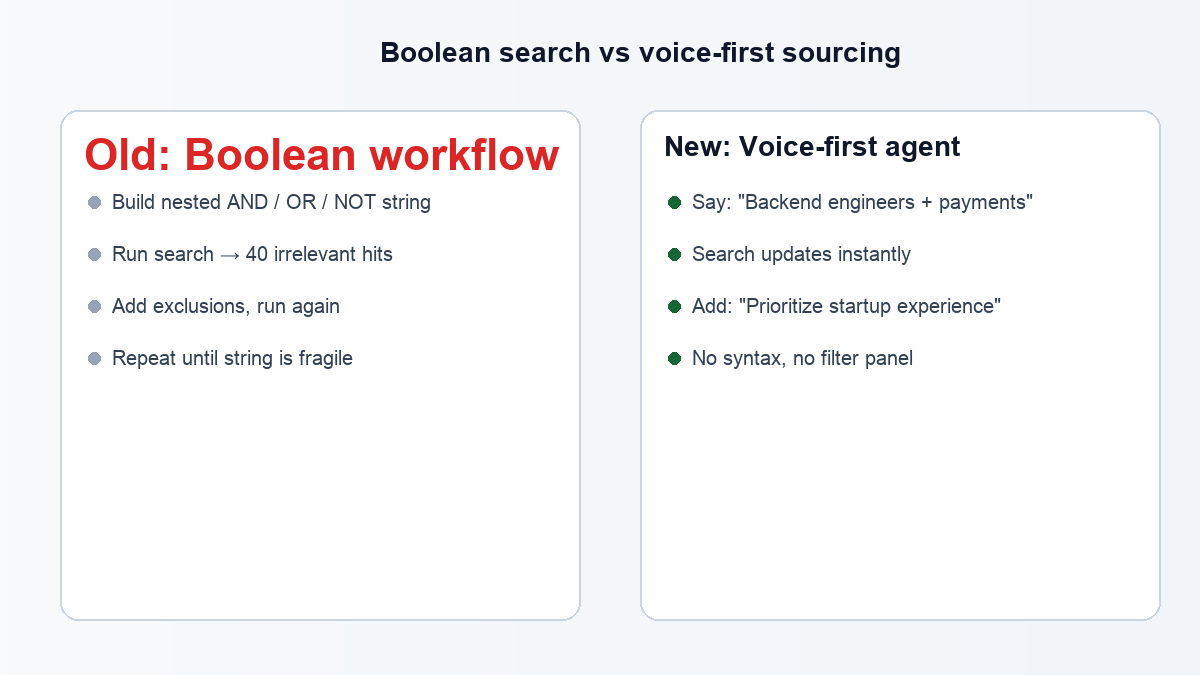
Here's the old way: a recruiter needs backend engineers with payments experience, so they open their sourcing tool and start building a Boolean string — ("backend engineer" OR "software engineer, backend") AND ("payments" OR "fintech" OR "stripe" OR "billing systems") AND NOT "frontend" — then run it, get 40 irrelevant results, add another exclusion, run it again, and repeat until the string is long enough that nobody else on the team could safely edit it without breaking the search.
Here's the new way: a recruiter says, out loud, "Find me more backend engineers with payments experience," and the search updates. They add, "Actually, prioritize startup experience over years of management," and it updates again — no Boolean string, no filter panel, no syntax to remember.
That shift — from typed query syntax to spoken intent — is the actual story behind "AI recruiting agents" in 2026, and it's worth being precise about what changed, because the category is crowded with tools claiming the same thing at very different levels of honesty.
What voice-first sourcing actually replaces
Boolean search has been the default recruiting-sourcing interface for close to two decades, and the pain point was never that it didn't work — it's that it demanded a second skill set on top of recruiting itself. Every refinement to a search meant editing nested AND/OR/NOT logic correctly, and every hiring manager who wanted to say "actually, weight startup experience higher" had that request translated by a recruiter into search syntax, with a delay in between.
Natural-language sourcing tools removed the syntax layer years ago — type a plain-English description, get ranked candidates back. Voice-first agents remove the typing layer on top of that: instead of opening a tool and composing a sentence, a recruiter narrates the request the moment it occurs to them — leaving an interview, walking out of a hiring-manager kickoff, between calls — and the search updates before the thought has a chance to get lost in the next meeting. The mechanism is the same natural-language matching underneath; what changed is when and how easily the request reaches the system.
How it actually works, step by step
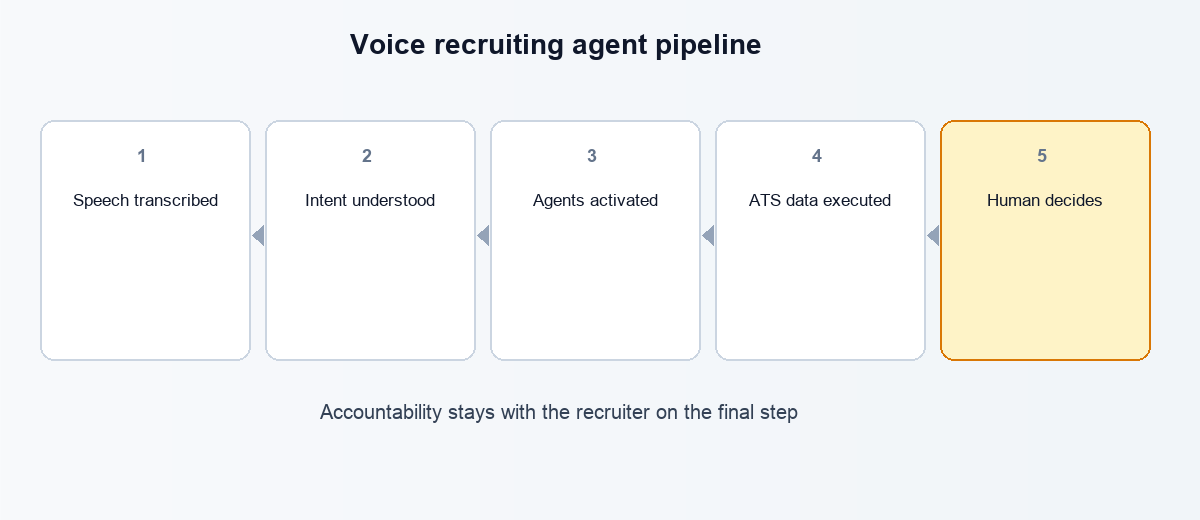
Behind a single spoken request, several distinct steps run in sequence, and understanding them matters for knowing where things can go wrong:
- Speech gets transcribed into text, preserving the specific phrasing of the request.
- A language model interprets intent — not just the words, but recruiting-specific meaning and follow-up context like "make it broader" or "find more candidates like this one."
- Specialized agents get activated for the specific task — one for updating a sourcing search, another for reviewing inbound applications, another for summarizing interview feedback — rather than one general-purpose assistant attempting everything.
- The work executes against real recruiting data — the company's ATS, candidate pipelines, interview feedback, historical hiring criteria — which is what separates this from a standalone chatbot with no context on the actual role.
- A human reviews and decides. The agent surfaces a shortlist, a summary, or a recommendation; the recruiter or hiring manager makes the actual call.
That last step is doing more work than it looks like, and it maps to a distinction worth keeping straight: an AI voice agent helps a recruiter direct AI-powered work faster — it never talks to a candidate. An AI voice recruiter is a different product entirely, one that conducts the phone screen itself. Conflating the two is where a lot of "AI is taking over hiring" anxiety comes from; the sourcing-and-triage agents this piece is about sit entirely on the recruiter's side of the conversation.
Where this shows up across the hiring funnel
The same conversational interface applies well beyond initial sourcing — the pattern generalizes to most of the repetitive work sitting between a recruiter and an actual hiring decision:
| Stage | What a recruiter says |
|---|---|
| Sourcing | "Find senior data engineers in Toronto with Snowflake experience." |
| Refining a search | "Expand to adjacent industries, keep fintech as the priority." |
| Application review | "Review everyone who applied overnight, show me the top candidates." |
| Hiring manager alignment | "Update the ideal candidate profile based on today's kickoff." |
| Interview insights | "Summarize the themes across every interview for this candidate." |
| Recruiting ops | "What's changed in our engineering pipeline this week?" |
None of these individually replace a recruiter's judgment. What they replace is the mechanical translation step — turning a verbally-expressed preference into a rebuilt filter, a re-sorted spreadsheet, or a manually compiled report — that used to eat the hours recruiters actually wanted to spend talking to candidates.
The market is already crowded, and "AI-powered" means very different things
Worth knowing before picking a tool: natural-language and voice-driven sourcing isn't one company's idea, it's the direction the entire category moved. Juicebox (also known as PeopleGPT) built its whole identity around plain-English search across an 800M+ profile index and is generally credited with making natural-language sourcing feel normal in the first place. hireEZ replaced manual Boolean-string building with an AI layer that converts natural language into search logic behind the scenes across 45+ platforms. SeekOut leans the opposite direction — less about conversational ease, more about depth (GitHub contributions, patents, published research) for genuinely hard-to-fill technical roles. Wellfound's Reach product lets recruiters spin up multiple parallel AI agents from voice-to-text input, testing different search angles — company pedigree, role language, location — simultaneously. And a newer wave, including tools like Noon, pushes further into fully autonomous sourcing-plus-outreach with less human steering per search.
The honest caveat sitting underneath all of it: SHRM's 2026 State of AI in HR report found that while 64% of companies have now used AI somewhere in recruiting, most implementations stay shallow — job description generation and basic resume screening, not the deeper sourcing-and-triage workflows the newer voice-first tools are built for. Adoption of the interface (voice, natural language) has moved faster than adoption of the depth these tools are actually capable of.
The gotcha nobody's marketing page leads with: this is a regulated category now
Here's the part worth taking seriously before wiring a voice agent into a live hiring pipeline: an AI system that "reviews everyone who applied overnight and shows me the top candidates" is, by definition, exactly the kind of tool New York City's Local Law 144 was written to cover. LL144 applies to any Automated Employment Decision Tool that substantially assists or replaces discretionary hiring decisions for a New York City–connected role — and the city's own guidance is explicit that this includes chatbots and screening agents that triage candidates into qualified and not-qualified buckets, not just formal scoring algorithms. A human staying "in the loop" reviewing the AI's shortlist does not exempt the tool if the AI's output is what the human is actually relying on.
The law requires an independent bias audit no more than a year before the tool is used, public disclosure of the audit results, and advance notice to candidates that an automated tool is involved — and enforcement, historically inconsistent, is explicitly ramping up in 2026 after a December 2025 comptroller's report found the city's own enforcement agency had been under-enforcing it. New Jersey, Illinois (AIVII), Maryland (HB 1202), and California (ADMT rules) are building similar requirements, meaning "just don't hire in NYC" is a shrinking loophole, not a real strategy.
This isn't a reason to avoid these tools — it's the same "external verification before it's forced on you" pattern that's showing up across every category of AI agent making consequential decisions, not just recruiting and not just generic chatbots. It's a reason to ask a vendor for their bias-audit summary before rollout, the same way you'd ask about uptime or data retention, rather than discovering the requirement after a candidate complaint.
What this actually means if you're evaluating one of these tools
A few concrete things worth checking before adopting a voice-first sourcing agent, beyond which one has the cleanest demo:
- Confirm which side of the conversation it sits on. A voice agent helping your team direct work is a very different risk profile than a voice recruiter talking to candidates directly — the compliance and disclosure obligations differ sharply between the two, and vendors don't always make the distinction as clearly as they should.
- Ask for the bias-audit summary, not just the sales deck. If a tool triages or ranks candidates in any way that a recruiter relies on more than other inputs, LL144 (and its growing list of state equivalents) almost certainly applies, whether or not the vendor volunteers that.
- Separate "faster interface" from "better matching." Voice removes friction in expressing what you want; it doesn't inherently make the underlying candidate-matching more accurate. Evaluate those as two separate claims, because most vendor demos blur them into one.
- Watch where the specialized-agent architecture actually helps. The real value isn't the voice input itself — it's routing a single spoken request across the right combination of sourcing, review, and reporting agents without the recruiter having to manually stitch tools together. If a tool is just voice-to-text bolted onto a single search box, it's not the same category.
The interface changed — from typed syntax to spoken intent — and that's a genuine, useful shift. What didn't change is that a tool influencing who gets hired is still a tool worth auditing, whether it's a Boolean string a recruiter built by hand or an AI agent updating a search from a voice note in an elevator.