Core concepts
- Drives: Persistent storage mounted into a sandbox as a directory, reusable across many separate runs — see our full Drives breakdown for the technical details. Vercel Sandbox Docs
- One writer, many readers: A Drive supports one read-write mount at a time, but any number of sandboxes can mount read-only snapshots concurrently — fan out from one source of truth safely.
- Tight integration with the Vercel AI stack: The main advantage for teams already on Vercel — one less external service to wire in.
What Is It?
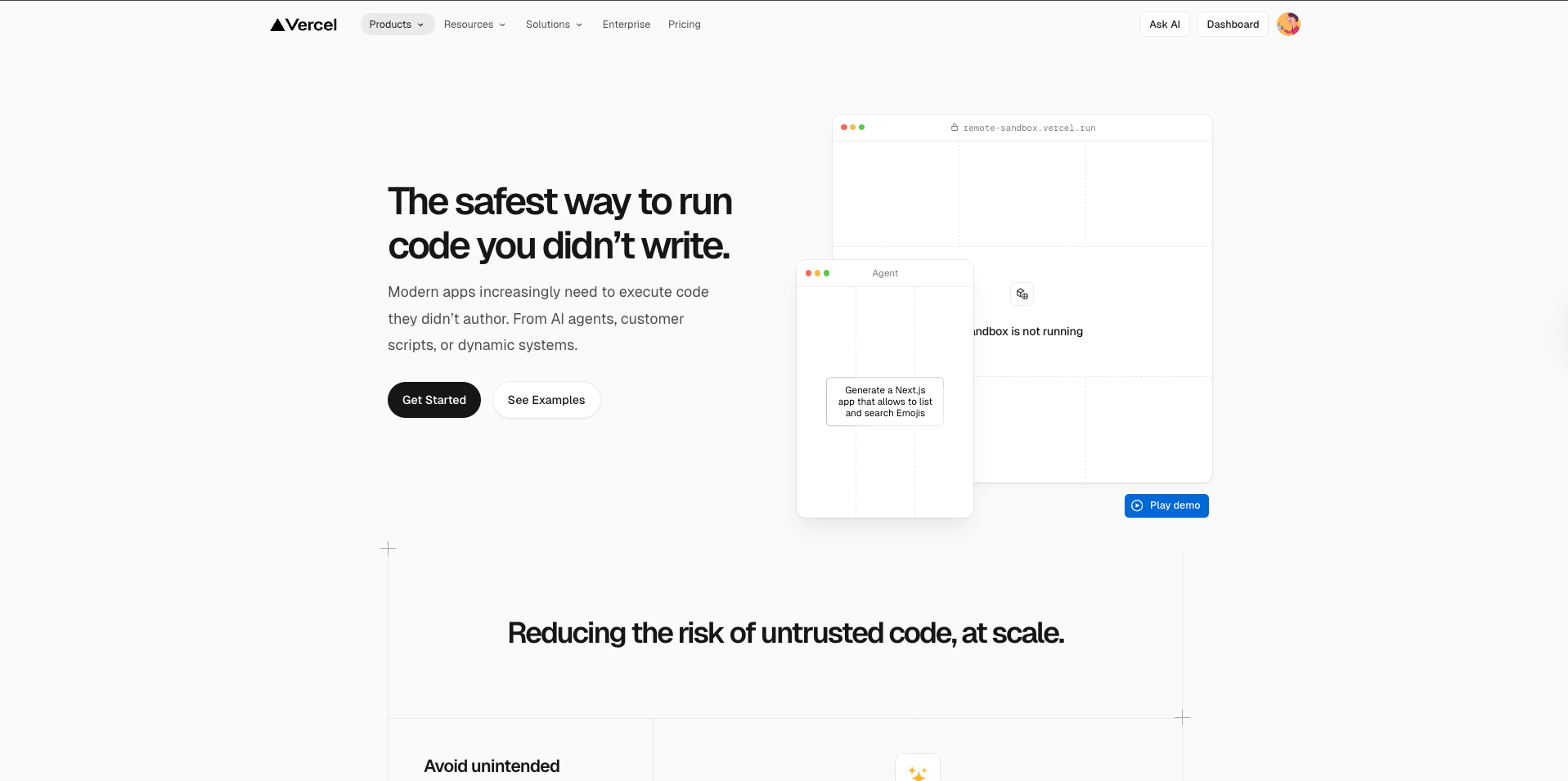
Vercel Sandbox runs isolated commands in Vercel's platform alongside AI SDK apps.
Drives provide shared persistent storage with controlled write concurrency.
Fits teams already deploying Next.js + Vercel AI SDK.
Why Should I Care?
Low friction if frontend and agent already live on Vercel.
Drive semantics help multi-step agents pass files safely.
Real World Analogy
Vercel Sandbox Drives are shared whiteboards with one marker holder — many agents can read, only one writes at a time to avoid scribble collisions.
Visual Mental Model
Vercel AI stack
  sandbox exec + Drive storage
Beginner Explanation
Vercel Sandbox integrates with the Vercel AI stack and Drives (one writer, many readers) for artifacts agents share across steps.
Smallest Possible Example
# Vercel Sandbox + Drives: one writer, many readers
print("edge-friendly agent isolation")
Common Mistakes
❌ Multiple writers to the same Drive without coordination.
Race conditions corrupt shared artifacts.
❌ Assuming sandbox replaces backend secrets management.
Still use env secrets and least privilege.
❌ Long jobs on request-bound sandboxes.
Use background workflows for lengthy agent tasks.
Real Project Example
v0 and Vercel AI demos increasingly use sandboxed tool runs.
Next.js startups on Vercel wire agent codegen into Sandbox APIs.
Build This Mini Project
Diagram a two-step agent where step1 writes a JSON plan to a Drive and step2 reads-only executes — note writer lock.
Interview Question
What problem do Vercel Drives solve?
Shared persistent storage between agent steps with one-writer-many-readers semantics to avoid concurrent write corruption in serverless environments.
Key Takeaways
- Great on Vercel AI stack.
- Drives coordinate shared artifacts.
- Respect single-writer rule.
- Offload long jobs from HTTP requests.
Resources
YouTube learning
Core concepts from video walkthroughs:
The 60-second story
You already live in one building: the Vercel app, the AI SDK, the deploy button your team actually uses. Vercel Sandbox is a work room in that same building so an agent can run code without you introducing a second landlord. The win is not a magical new kind of CPU. The win is fewer keys on the ring.
Drives are the shared shelf. You mount a directory into the room. The room can die. The shelf remains, so the next run does not start from an empty desk. That is the same “hall locker” idea, with their name on it. One writer at a time keeps the shelf from becoming a mural painted by six people at once. Many readers can mount a snapshot. That is a fan-out: one person updates the brief, a crowd of rooms can read it without trampling the file.
The snapshot matters. Readers are not editing the live shelf. They are reading a picture of it. If you need them to see a new file, you publish a new picture. If you let everyone mount read-write, you do not have a shelf. You have a race.
Map the building.
- The sandbox is a work room next to the app you already ship.
- A Drive is the shelf that outlives the room.
- One writer protects the shelf.
- Many readers share a snapshot, not the pen.
- Staying on Vercel is one less landlord.
- A second landlord is still correct when you need a GPU bay or a different wall.
writer updates the Drive
readers mount a snapshot
rooms die
the shelf stays
Use that when the agent’s code needs a tree of files between runs: a repo, a cache, a generated report. Do not use it to stash production secrets because the mount was easy.
This product exists for teams whose agent is already a Vercel-shaped thing and who want isolation without a new vendor review. The one-writer rule exists because shared filesystems get corrupted by optimism. The snapshot rule exists so readers stay repeatable.
Mental model: a work room and a shelf with one pen. Plenty of people may look at a photo of the shelf. One person writes.
You can explain the page if you can say what Drives persist, and why “many readers” does not mean “many editors.” A photo of the shelf can be shared widely. The pen stays with one person so the files do not turn into a mural.