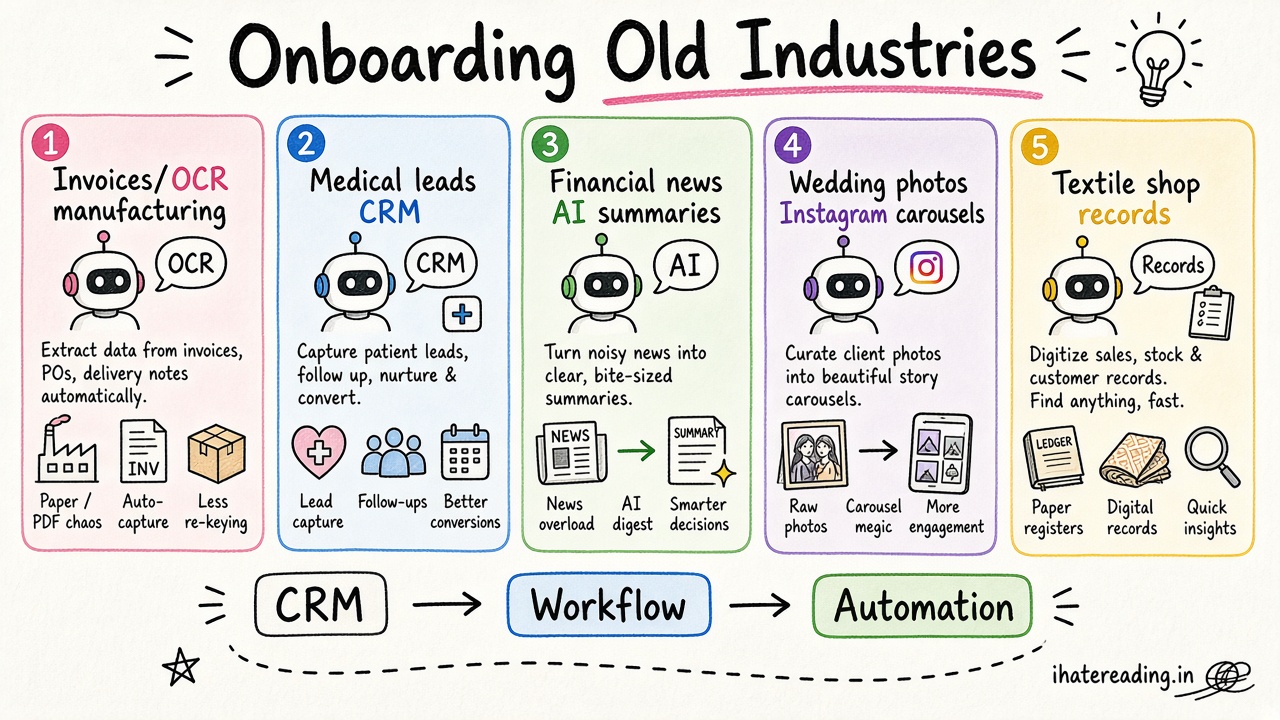
Every business runs on a loop. Find customers, serve them, record what happened, repeat. A system is just a loop someone bothered to formalize — and a CRM is where that system gets created, managed, and run. Customers want better products, better content, better features; the CRM is the quiet place underneath all of that where the actual data room lives.
Say "CRM" or "dashboard" to a non-technical founder, though, and watch them glaze over. Those words confuse people and low-key scare them. Say automation or workflow instead, and the same founder leans in. That's not a branding trick — it's the actual insight this post is built on: the product barely changes, but the framing decides whether anyone buys it.
I've spent the last few months visiting old-economy business owners in India — manufacturers, medical equipment sellers, finance report writers, wedding photographers, a textile shop — trying to understand where AI-powered workflows actually fit into businesses that have never touched one. Here's what five visits taught me, and the pattern underneath all of them.
Two categories of business, not two channels
The useful split isn't offline vs. online. Every business that operates offline but puts any content online — Instagram, a website, a listing — already needs something to manage that content. The real split is technical vs. non-technical. Technical teams can wire up Zapier or an AI agent builder themselves. Non-technical owners need someone to hand them a working system, priced simply, with zero learning curve.
That's the category I'm building for, and it's the same category behind iHateReading's micro-SaaS ideas actually making money in 2026 — small, boring, workflow-shaped products sold to people who don't care what's under the hood.
Visit one: 500 invoices, one Excel sheet, six hours a day
A manufacturing founder — chemicals and foods — was printing 500 invoices daily and having 20 employees manually read and categorize each one into Excel. That's not a workflow gap, it's an AI OCR problem, solvable with one API, one dashboard, one database:
- A dashboard for uploading invoice images and rendering them as a table.
- A backend AI API that reads each image, understands context, categorizes it, and stores it.
The economics make the pitch: the AI LLM API is the highest cost at roughly $0.01/image, so 500 images/day runs $1–5, or about ₹100–500. CRM deployment is free. Database cost stays near zero if you delete raw invoice images after processing and keep only the key-value data. API hosting is effectively free at that call volume. A 6-hour job for 20 people becomes a sub-$10, sub-30-minute task — and that's per customer, per dashboard, so the economics scale linearly with every manufacturer you sign.
If you're comparing build vs. buy on scraping and enrichment APIs, our Firecrawl vs ScrapingBee vs ScrapeFast breakdown is the same math in a different vertical — unit cost per call, not seat licenses.
Visit two: medical equipment, government tenders, and the leads problem
The second owner sold medical equipment to doctors and hospitals, largely off government tenders. Understanding why he needed leads clarified how to solve it: Google Maps, Google, and Instagram scrapers can find doctors and hospitals by area or district, with an AI layer to resolve the right contact's email or phone. Feed that onto a dashboard as daily or monthly leads, and he has something to act on every morning.
But leads alone don't hold someone inside your product. The move is to keep pulling him deeper — manage existing clients in the same CRM, generate invoices there too — because the more of the business that runs through it, the more data you have, and the better an AI agent layered on top can get. This is the same lead-scraping-to-dashboard shape covered in the B2B agencies AI agent piece and from finding clients to a smart SaaS scraping dashboard.
There's a real limit here, though. Some businesses won't need the full CRM — logging every small open-item sale into a dashboard is boring, and nobody does it unless a hard rule forces them to, like GST billing or tax compliance. Even then, most owners will just keep it in their heads. The lesson: always look for the easiest possible version of the product, not the most complete one. Zero learning curve beats more features.
Visit three: a one-man financial news desk
This owner wrote financial news reports by hand — reading dozens of sources, opening endless tabs, downloading reports, and saving them into folders. The fix was obvious once the workflow was visible: a dashboard that pulls daily reports from the internet automatically, an AI agent that summarizes each one, and an editor inside the dashboard to draft new reports from those summaries. Priced either as a one-time build plus a yearly storage-and-API plan, or as a straightforward monthly SaaS fee — whichever the owner found easier to say yes to.
Same shape as generating summaries for hundreds of articles — batch ingest, LLM pass, human edit — just sold as a vertical newsroom instead of a content marketing team.
Visit four: a wedding photography studio
A photography and events team said what they needed was leads — more wedding and event bookings. Leads alone are a vitamin here, not a painkiller; nice to have, not urgent enough to pay for on their own. So the actual hook was different: a tool where they upload the day's 10–30 photos and get back ready-to-post Instagram carousels and captions, with an IG API wired in so they can post straight from the dashboard. That's the feature that gets the "ahh" reaction and makes the dashboard something they open daily — the lead-gen layer rides in on top of a habit they'd already want, instead of being the whole pitch.
Visit five: a family-run bathroom equipment and textile shop
An old, multi-generation family business with heavy foot traffic across several floors and shops. No record of visitor details for future contact. No sales record of what actually sells. Employee attendance tracked nowhere, despite a sizeable staff across multiple floors. None of this needed convincing — the gaps were visible within a few hours of just standing in the shop and watching how it ran.
The pattern underneath all five
Recognizing patterns is the actual skill here, more than any individual build. Walk through every department of a business asking "how could this be better," pull analogies from other verticals, add creativity — I once thought about wiring cameras for real-time employee monitoring in the manufacturing case, only half-joking. The deeper habit is thinking in layers: start with the vitamin (something nice, low-friction, easy to say yes to), and slowly work toward the painkiller (something they can't operate without). The vitamin vs. painkiller framing is a well-worn product lens for a reason — painkillers get faster adoption and stronger retention because they solve something urgent, while vitamins need to earn their way in slowly, through habit and trust, exactly like the Instagram-carousel hook did for the photography studio before the CRM underneath it ever got used seriously.
Why bother with boring industries at all
Selling into old, offline, non-technical businesses is a genuinely harder go-to-market than shipping another developer tool. Trust takes longer. Sales cycles are slower. Nobody's tweeting about your product. But this is the same bet YC keeps making explicitly — its own people have said outright that they love unsexy industries, and its recent founder wishlists keep pointing at the same theme: the companies that looked boring at first — Stripe, Brex, Flexport, Coinbase, Deel — are the ones friction turned into billion-dollar outcomes once someone actually removed the pain. Once you're in a boring, offline, slow-moving business, you're not getting displaced. Nobody switches vendors for a tool that quietly saves them six hours a day, and nobody else is fighting you for the account either.
I call this onboarding old industries — not swapping a business's computer, not making them learn new software, just integrating AI into the workflow they already run, so it reads as relief instead of a chore. CRMs and dashboards are boring by nature, and that's fine. The businesses that win here won't have the flashiest interface. They'll be the ones where the owner forgets they're even using software — it just feels like the shop finally keeping up with itself. That's also the exact instinct behind why I keep building CRM templates in the first place: the market for dead-simple, workflow-shaped CRMs isn't shrinking, it's just badly served.
More visits, more patterns, coming in the next one.
— Shrey